Data Justice
Data shapes nearly every decision that touches our lives—from who gets healthcare to which communities receive investment or attention. But data doesn’t collect itself, and it isn’t neutral. Data justice means asking who controls the information, whose stories are missing, and how we can use data to build trust and accountability instead of reinforcing harm. It’s about putting people, not just numbers, at the center of what we measure and why.
| Watch our Video Series on Data Justice |
|---|
In 2021, the Maine State Legislature enacted and the Governor signed PL 2021, c. 717, “An Act to Promote Equity in Policy Making by Enhancing the State’s Ability to Collect, Analyze, and Apply Data” and its companion legislation PL 2021, c. 21, “An Act to Require the Inclusion of Racial Impact Statements in the Legislative Process.” Through these combined efforts, the state of Maine aims to improve how demographic data is collected, analyzed, and governed so that it can be used in the policy process. These efforts also seek to improve the efficiency with which state agencies — who are often at the forefront of data collection — can share information.
This report is a supplement to Maine’s ongoing data governance effort, laying out the importance of robust and targeted demographic data collection. To the Permanent Commission, this means not just more data, but new types of data and analysis that uplift the unique needs and assets of Maine’s communities so that policy is based on the knowledge and experiences of real people. While we know that as state actors we have work to do to ensure that our data represents all Maine communities, we also recognize that quantitative data alone — even at fine levels of granularity — can obscure the unique needs of smaller communities or those that are not fully or accurately reflected in statistical averages.
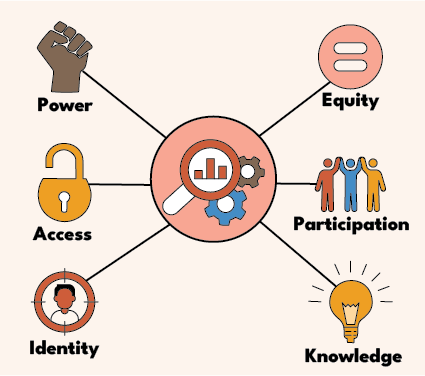
| Data Justice Frameworks |
|---|
 |
In addition, while we strongly support efforts to improve data, this report acknowledges concerns around data privacy, ownership, and ethical use, especially for people of color and those from Indigenous communities who are often the target of data collection but rarely consulted about what data will be collected or how it will be used. As we advance an authentic desire to expand and improve Maine’s current demographic data to better serve all Maine people, history tells us we must also acknowledge these valid concerns, and explore models of data governance that address them. In this report, we lay out some perspectives for consideration and focus in particular on three important points:
- Racial data — even as raw numbers in a database — are not “neutral,” but instead draw upon particular ways of dividing human communities that have real implications for individual people and for our society as a whole.
- The collection of more data does not inherently resolve issues of racial inequality, unless that data “is used, for good, and only for good.”
- As data becomes more central to state functions and decision-making processes (e.g., through the use of AI technology), risks associated with data collection are amplified in communities of color.